THE PRAGUE LUNCH CLUB
How do you do lunch in Prague? Restaurants, takeaway, delivery, homemade lunches, a bag of rohlíky or a really good bowl of soup. There’s no single way to do lunch in Prague — and that’s part of the fun.
The SMAŽÁK Editorial Team
SMAŽÁK NOVINY · PRAGUE LIFE & FOOD CULTURE · OCTOBER 2026
THE 11:30 QUESTION
It’s lunchtime in Prague.
Somewhere in Karlín, colleagues are deciding where to eat. In Vinohrady, someone is checking the daily menu outside a neighbourhood restaurant. Across town, a delivery courier is collecting another order.
Someone else is heating up yesterday’s dinner.
And somebody has just walked out of a supermarket carrying a suspiciously large number of bread rolls.
Different people. Different routines. Same question.
What’s for lunch?
For anyone new to Prague, understanding how people eat during the working week is one of those small discoveries that can make everyday life here much easier.
You don’t need to eat Czech food every day. You don’t need to visit restaurants five times a week. And you certainly don’t need to spend half your lunch break deciding what to eat.
Some days you want a proper meal with colleagues. Other days you grab something on the way back to work, order delivery or make lunch from whatever is in the fridge.
And sometimes all you need is a good bowl of soup.
Welcome to the Prague Lunch Club.
No membership required.

THE CZECH LUNCH SYSTEM
One of the most useful things to learn about eating in Czechia is the polední menu.
Many restaurants prepare a shorter selection of dishes specifically for weekday lunch, often at different prices from their regular menu.
These offers usually run during a limited lunchtime window, although the exact hours vary.
For newcomers, understanding a few Czech expressions can make an enormous difference.

FIVE WORDS THAT MAKE LUNCH EASIER
Polední menu — Lunch menu.
Denní menu — Daily menu.
Polévka dne — Soup of the day.
Hlavní jídlo — Main course.
S sebou — To take away.
And one more worth remembering:
Dobrou chuť! — Enjoy your meal!
One important detail: soup isn’t necessarily included in the advertised lunch price. Some restaurants offer it separately, while others have a discounted combination.
Check before ordering.
Once you understand the system, you start noticing possibilities everywhere.
A restaurant that looks expensive in the evening might have a reasonably priced weekday lunch.
A traditional Czech pub might serve an excellent daily special.
And a small neighbourhood bakery might have everything you need for a quick midday stop.
The trick is to look beyond the regular menu.
LET’S TALK MONEY: WHAT DOES LUNCH IN PRAGUE ACTUALLY COST?
A restaurant lunch, a bowl of soup, a daily special or a quick supermarket stop. Prague gives you plenty of choices — but the prices can be surprisingly different.
According to the Edenred Restaurant Index, average lunch spending in September 2026 reached:
Location | Average lunch spending |
|---|---|
Prague | 229.70 Kč |
Brno | 217.30 Kč |
Czech national average | 202.90 Kč |
For comparison, the national average was 139.10 Kč in September 2020 — an increase of approximately 46%.
These figures reflect transactions monitored by Edenred, not every restaurant in the country. They also represent average lunch spending, rather than the price of a particular dish or a guaranteed two-course menu.
Still, they raise an interesting question.
If you’re buying lunch every working day, how much does it actually add up to?
BUT WHAT IF YOU JUST WANT SOUP?
Here’s where lunch gets interesting.
In selected Prague restaurant menus from October 2026, we found:
Soup | Listed price |
|---|---|
Plavecká Polévka | 65–85 Kč |
U Kroka — garlic soup | 135 Kč |
U Kroka — kulajda | 155 Kč |
That’s quite a difference for something we simply call polévka.
But not all soups are created equal.
A small starter, a generous bowl of kulajda and a substantial noodle soup aren’t necessarily comparable meals.
Before deciding which is better value, look at the portion size, ingredients and whether bread or another accompaniment is included.
A soup costing 150 Kč might be better value than one costing 80 Kč if it replaces an entire meal.
Or it might not.

AND WHAT ABOUT SOUP PLUS A MAIN COURSE?
Many Czech restaurants offer a polední menu (weekday lunch menu), sometimes with soup available at an additional or discounted price.
Others sell the soup and main course separately.
For example, selected October menu prices at Plavecká Polévka allowed a combination of soup and a main course for approximately 240–270 Kč.
That’s the combined price of two listed dishes, not a specially discounted lunch set.
A genuine soup-and-main lunch deal may cost less than ordering both separately, but the price and what’s included vary by restaurant.
It’s always worth asking:
„Je polévka v ceně?“ — Is soup included in the price?
WHAT DOES THAT MEAN FOR YOUR MONTHLY BUDGET?
At Prague’s reported average of approximately 230 Kč per lunch:
Five purchased lunches: around 1,150 Kč.
Twenty purchased lunches: around 4,600 Kč.
That doesn’t mean everyone spends this amount. And preparing lunch at home has its own costs.
But it helps explain why mixing different lunch routines can make sense.
A restaurant one day. Something homemade the next. A takeaway when the schedule gets complicated.
It’s not always about finding the cheapest option.
Sometimes it’s simply about finding a routine that works.
The best-value lunch isn’t necessarily the cheapest. It’s the one that gives you what you need that day — whether that’s a satisfying meal, a quick break or a chance to sit down with someone.
SIX WAYS TO DO LUNCH IN PRAGUE
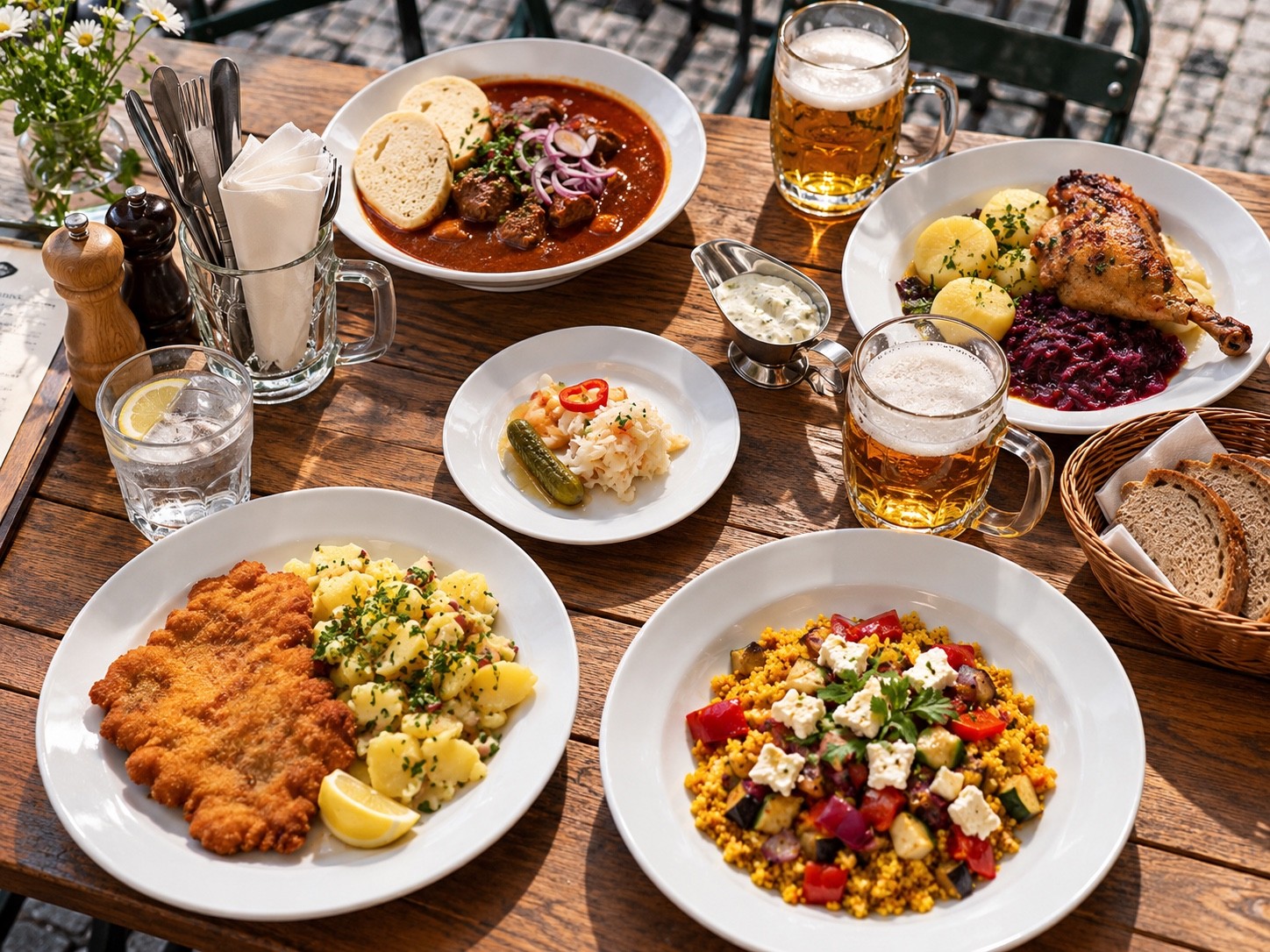
01 — THE PROPER LUNCH BREAK
Some days, lunch deserves its own place in the calendar.
A table, a warm meal and perhaps a conversation that isn’t interrupted by emails.
This is where Prague’s neighbourhood restaurants, traditional Czech pubs and contemporary bistros come into their own.
Look for the daily lunch offer, especially away from the most tourist-heavy streets.
And don’t underestimate the social side of lunch.
For someone new to Prague, inviting a colleague or neighbour to lunch can be one of the easiest ways to get to know people.
No elaborate plans required.
Just a simple invitation.
Shall we go for lunch?
Or, in the spirit of SMAŽÁK:
Jdeme na smažák?
02 — THE TAKEAWAY LUNCH
For days when you have twenty minutes between meetings.
A bakery, bistro, soup kitchen or takeaway counter can be a welcome alternative to a full restaurant meal.
Prague has plenty of places where you can collect something freshly prepared without committing to a long lunch break.
The advantage is flexibility.
The disadvantage? A quick takeaway doesn’t always mean a cheaper or more satisfying lunch.
Check portion sizes, extras and whether you actually need that second item you’re about to order.
03 — THE DELIVERY DAY
Sometimes leaving the house or office simply isn’t practical.
Delivery can be convenient, especially when you’re working from home or dealing with a packed schedule.
But delivery fees, service charges and minimum order requirements can change the final price considerably.
It’s worth comparing the total with collecting the food yourself.
And if you find a restaurant you particularly enjoy, see whether it offers direct ordering or pickup.
Convenience is valuable.
It just helps to know what you’re paying for.
04 — THE ROHLÍK LUNCH
Possibly the most Czech lunch you’ll never find on a restaurant menu.
Walk past a supermarket around lunchtime and you might notice something wonderfully ordinary.
Someone leaving with a thin, almost transparent plastic bag containing three, four or perhaps six rohlíky.
Those familiar Czech bread rolls.
In the same shopping bag?
Maybe a tub of vlašský salát, pochoutkový salát or pařížský salát — classic Czech deli salads, often made with mayonnaise, vegetables and processed meat.
Perhaps a little tin of Májka pâté.
Or some packaged ham and cheese.
Then it’s straight back to work.
No reservation. No delivery fee. No waiting for a table.
Just a few rohlíky and whatever you fancy eating with them.

And here’s something worth knowing.
Think of the French and their baguettes.
For Czechs and Slovaks, the humble rohlík holds a similarly special place in everyday life.
It’s not fancy. It’s not expensive. And nobody really thinks twice about buying a few on the way home.
It’s there for breakfast, packed into school bags, eaten at work, served with soup or grabbed for a quick snack.
Much like the French baguette, it’s one of those simple foods that somehow becomes part of a country’s identity.
The French have their baguettes. Czechs and Slovaks have their rohlíky.
Of course, a rohlík isn’t a baguette. They’re different breads with different histories.
But their place in everyday food culture makes for a lovely comparison.
And the supermarket rohlík lunch?
It’s practical, flexible and can be relatively inexpensive.
For some people, it’s a perfectly satisfying midday meal.
For others, it’s simply what happens when lunch needs to be quick.
The rohlík itself deserves a whole story — and we’ll give it one.
For now, consider this your introduction to one of Czechia’s most unpretentious lunch habits.
Sometimes lunch isn’t a meal you order. It’s a little bag you carry back to work.

05 — THE HOMEMADE LUNCH
Not every good lunch comes from a restaurant.
Leftovers from yesterday’s dinner, a homemade sandwich, pasta, a salad or a container of soup can make an excellent midday meal.
And preparing food at home doesn’t have to mean complicated meal planning.
Sometimes the simplest approach works best: cook a little extra in the evening and save a portion for tomorrow.
There’s also something satisfying about opening your lunchbox and knowing exactly what’s inside.
And perhaps the greatest advantage?
You decide what goes into it.
06 — THE SOUP-ONLY LUNCH
Now here’s something worth discussing.
Can soup really be a complete lunch?
If you’re thinking of a small cup of broth before a main course, perhaps not.
But a generous bowl of Czech gulášová, creamy kulajda, Georgian borscht, Vietnamese pho or Chinese beef noodle soup is a different proposition.
Depending on the ingredients and portion size, soup can be a substantial meal.
And in Prague, there are places where soup isn’t an afterthought.
It’s the whole reason to visit.

SOUP IS SERIOUS BUSINESS
Soup occupies a familiar place in Czech and Slovak food culture.
For many people, it brings back memories of family lunches, school canteens or a pot simmering on the stove.
But it’s also part of everyday restaurant life.
You’ll regularly encounter soup on weekday lunch menus, sometimes as a small starter and sometimes as something much more substantial.
And while Czech classics deserve attention, Prague’s soup culture doesn’t end with kulajda and česnečka.
Vietnamese pho, Georgian borscht and Chinese noodle soups are part of the city’s diverse food landscape.
Each comes from a different culinary tradition, with its own ingredients, preparation and history.
What connects them is something simple: a good bowl of soup can be a wonderful reason to stop for lunch.
And for anyone new to Czech food, a few classics are worth recognising:
Kulajda — A creamy, slightly tangy soup traditionally associated with mushrooms, potatoes, dill and egg.
Česnečka — A garlic soup often served with potatoes, croutons or cheese.
Gulášová polévka — A hearty, paprika-rich soup, often containing beef and potatoes.
Bramboračka — A traditional potato and vegetable soup, commonly flavoured with mushrooms and marjoram.
Vývar — A clear meat or vegetable broth, often served with noodles or dumplings.
Kapustnica — A Slovak sauerkraut soup with many regional and family variations, often associated with Christmas traditions.
You don’t need to try all of them in one week.
But the next time you see polévka dne on a menu, you might find something worth discovering.

WHERE WE GO FOR SOUP IN PRAGUE
A selection of favourite soup stops from the SMAŽÁK editorial notebook. Czech classics, Georgian flavours, Vietnamese pho and Chinese noodles — because discovering Prague means discovering all the people and cuisines that make up the city.
POLÉVKÁRNA — KARLÍN
Best for: A quick soup-focused lunch
A place where soup is the main attraction rather than something you order before the real meal.
A useful stop when you want something warm, straightforward and easy to fit into a working day.
PLAVECKÁ POLÉVKA — PRAGUE 2
Best for: A neighbourhood soup stop
A compact soup-focused bistro with a changing selection.
A good option for a simple weekday lunch, especially if you’d rather have a bowl of something warm than a large restaurant meal.
U KROKA — PRAGUE 2
Best for: Czech classics in a sit-down restaurant
For a more traditional Czech restaurant experience, U Kroka is one of our selected stops.
Kulajda is a particularly good introduction to the country’s distinctive soup traditions, with its creamy, mushroom-and-dill character.
ANTONÍNOVO PEKAŘSTVÍ — MULTIPLE PRAGUE LOCATIONS
Best for: Soup and fresh bread
Sometimes the simplest combinations are the most satisfying.
Antonínovo is a useful bakery stop when you want something warm with fresh bread or another baked accompaniment.
Soup availability can vary by branch and day.
POLÉVKÁRNA PANÍ MANČO — PRAGUE
Best for: Georgian comfort food
A reminder that Prague’s soup scene extends far beyond Czech classics.
Georgian borscht and freshly prepared khachapuri offer a different kind of comforting lunch.
PHONG’S BISTRO & CAFÉ — PRAGUE 7
Best for: A Vietnamese lunch
One of our saved neighbourhood discoveries for Vietnamese food.
A good place to consider when you’re in the mood for something different from a Czech lunch special.
TRÀNG AN — PRAHA 7, HOLEŠOVICKÁ TRŽNICE
Best for: Vietnamese flavours
Another favourite from the SMAŽÁK notebook, located in Holešovická tržnice.
A reminder that a satisfying lunch can come in one bowl, with noodles, broth, herbs and plenty of flavour.
LAMI – LANZHOU NOODLES — PRAGUE 1
Best for: Chinese hand-pulled noodles
A different approach to noodle soup, where the noodles themselves are central to the experience.
An interesting alternative for anyone who enjoys a substantial, broth-based meal.
Menus, prices and opening hours may change. Check the latest information before visiting. These are editorial recommendations, not paid placements.
SO, WHAT’S YOUR LUNCH SYSTEM?
Maybe you have a favourite restaurant where the staff already know your order.
Maybe you bring lunch from home four days a week and treat yourself on Friday.
Maybe you work remotely and lunch depends entirely on how busy the day becomes.
Or perhaps you’re still discovering Prague and haven’t found your routine yet.
There’s no perfect system.
And maybe that’s the point.
A good lunch isn’t always about finding the most fashionable restaurant, spending the least money or choosing the healthiest-looking dish on the menu.
Sometimes it’s about getting away from your desk.
Sometimes it’s about sharing a table.
Sometimes it’s about trying somewhere new.
And sometimes it’s simply about having twenty peaceful minutes with a bowl of soup.
ONE LAST THOUGHT
We spend a surprising amount of our lives deciding what to eat.
But the most memorable lunches often aren’t the most elaborate ones.
They’re the unexpected conversation with a colleague. The little bistro discovered by accident. The soup that reminds you of home. The place you return to because someone made you feel welcome.
So perhaps the real question isn’t just:
“What’s for lunch?”
Perhaps it’s also:
“Who could we share it with?”
And if you don’t know where to begin, there’s always a very Czech invitation.
Jdeme na smažák?
SMAŽÁK — BACK TO THE TABLE.
SMAŽÁK ASKS
How do you usually do lunch in Prague?
Restaurant, takeaway, delivery, homemade — or a bit of everything?
Have you tried the Czech rohlík lunch yet? And what’s your favourite combination?
Tell us your favourite lunch spot. The SMAŽÁK team is always looking for new discoveries.

OUR FIRST PLACES ARE ON THE WAY.
Once checked, you will find places to share a table across Czechia and Slovakia.